A field guide to Donut Place
HOW WE TEST
This page is the contract. Every figure on the site carries one of four marks, and the mark says who produced the number — us, the client, or the store page.
- TESTED the rules below were applied to every page, 2026-11-05
- IN-GAME nothing on this page is a quote from the client except the examples
- OFFICIAL ONLY the four mark names come from our own manual, not a store page
- NEEDS CHECK whether a reader can tell a copied figure from a measured one
The four marks
- TESTED — we did it, in the browser build, on the date the page carries.
The evidence is a frame from our own capture, kept in
research/. - IN-GAME — the client's own words, quoted exactly, with no number added and nothing tidied. If it is short and ungrammatical, it stays that way.
- OFFICIAL ONLY — the portal page or the developer's page, repeated as written. It is not a measurement, even when it is a number.
- NEEDS CHECK — we know the question matters and do not have the answer. The page says so where the reader needs it, not in a footnote.
There is no fifth category. A sentence with no mark is a mistake, not a fourth kind of certainty.
How a screen becomes a claim
A screenshot on its own proves nothing; anyone can crop a shop. So a capture is used three ways:
- the figure is read off the screen and written down with the date;
- the same screen is kept, uncropped, in
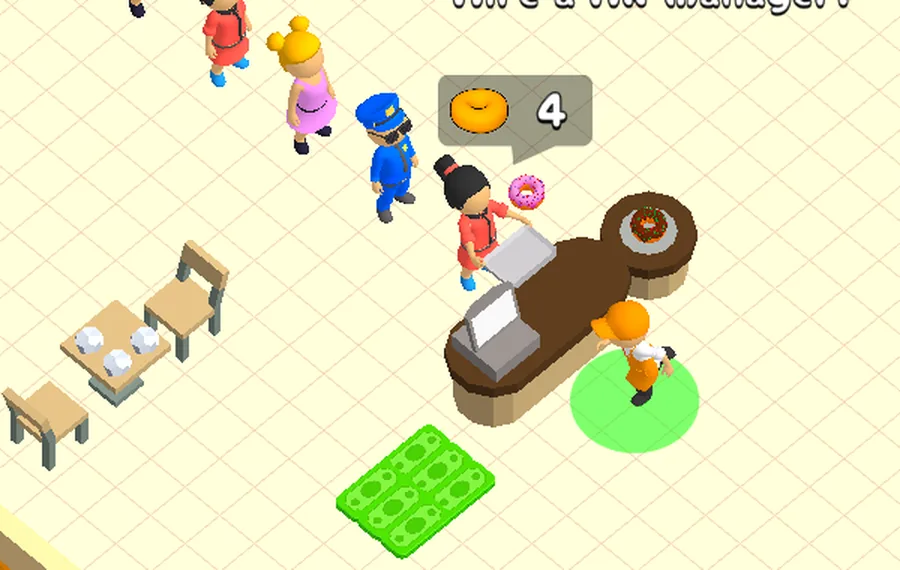
research/, so a reader can check the reading; - the caption under each image says what the picture proves — not what it depicts. "A queue at the counter" is a description. "The queue forms on the left and the customer waits there until a seat frees" is a claim, and the caption has to be able to carry it.
What we do not do
We do not copy another guide's numbers. We do not round a price to a rounder price. We do not turn a single session into a system: one shop at 9.09% progress is a data point, not a curve.
We also do not write the page we wish we had. Donut Place is a small browser game with a short tutorial, and a guide that pretends to have a full economy table after one session would be inventing half of it.
Where we have actually been
On 2026-11-05 we played one session and captured it end to end. From that
session the site can state: the starting cash (400), the two price tags we
could read (125 for a table, 120 for the HR room), the prompts the game
gives in order, and the NO SEAT! bubble a customer raises when seating runs
out.
Everything else — what a donut sells for, how the progress meter is fed, whether a day ends, what the kitchen unlocks — is either unmeasured or measured once. It is written as NEEDS CHECK until it is not.
What a reader can check without trusting us
Every figure points at a frame in research/, and every OFFICIAL ONLY line can
be checked against the portal page, which anyone can open. The date on a page is
the date of the last pass, not the date of the first draft: when a page is
re-checked, the date moves and the sentence that changed is rewritten, not
patched.
What happens when we are wrong
The client wins. If a reader finds a price, a prompt or a rule that disagrees with what this site prints, the site is wrong and gets fixed. The contact page lists what to send: the number you saw, the screen you saw it on, and the build date if you can find it.
Last checked against the client: 2026-11-05 · client web build 2026-11-05